
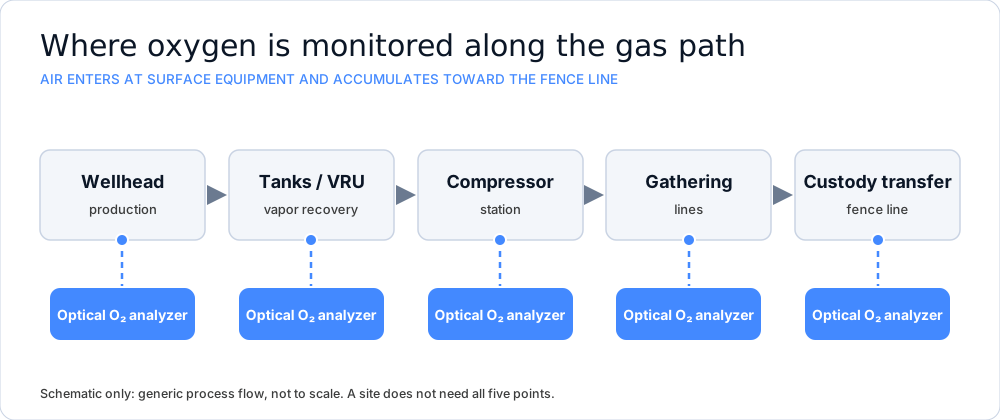
Produced gas leaves the reservoir essentially free of oxygen, so any oxygen in the stream is air that got in at the surface. Put an optical oxygen analyzer where air enters or where the spec is enforced. These are the applications, and where the analyzer mounts in each.
Tank vapor is pulled near atmospheric pressure, so air can leak in unseen. The analyzer reads that vapor before the VRU compressor.
Worn rod packing and shaft seals can pull air in at low suction. The analyzer reads what the station delivers on the discharge line.
Oxygen is still undiluted at the wellhead and traceable to one well. The analyzer helps you find the source before it blends into the gathering line.
Producer gas enters a midstream system here, along with any air that got in upstream. The analyzer screens that incoming gas against your pipeline limit.
Air enters at surface equipment that runs near or below atmospheric pressure, or has a path to the outside: wellheads, tank hatches, VRU suction, compressor seals and gathering-line fittings. The effects accumulate, so the stream at the fence line carries the sum of every upstream source.
| Application | Typical mounting location | Typical oxygen concern | Page |
|---|---|---|---|
| Vapor recovery units | The analyzer mounts on the vapor line between the separator and the VRU compressor. | Air can be drawn into low-pressure tank vapor. | Read this page |
| Gas compressor stations | The analyzer mounts on the compressor discharge line. | Air can be drawn in at rod packing and shaft seals. | Read this page |
| Wellhead and production | The analyzer samples at the wellhead or the production separator gas outlet. | Air can get in at low-pressure, plunger-lift and stripper wells. | Read this page |
| Custody transfer | The analyzer mounts just downstream of the fence line, on the midstream side. | Oxygen in incoming producer gas arrives at the receipt point. | Read this page |
| Gas gathering lines | The analyzer mounts on the trunk line upstream of the interconnect. | Air can enter through fittings, packing and welds. | Read this page |
| Tank blanketing | The analyzer mounts on the tank vapor line. | The blanket can fail, or air can enter the vapor space. | Read this page |
| Flare gas | The analyzer mounts on the flare header. | Air can enter the header, or purge flow can be too low. | Read this page |
The locations for vapor recovery units, compressor stations and custody transfer are the recommended points. Others are typical points and should be confirmed for your site.
One analyzer shows one point. If you need to trace a high reading, use more than one, for example at the wellhead, the compressor discharge and the fence line, so you can see the stage where oxygen first appears. Choose points where your spec is enforced and where you want to find a source.





There is no single place. Three recommended points are on the vapor line between the separator and the VRU compressor, on the compressor discharge line, and just downstream of the fence line at a custody transfer receipt point. Wellhead, gathering, tank and flare points are also used.
Reservoir gas is essentially oxygen-free. Oxygen in the stream is air drawn in at the surface, at equipment running near or below atmospheric pressure or through leaks.
No. Standard Sensors is based in Montgomery, Texas, and builds the analyzer for natural gas and oil and gas operators across U.S. basins.
Start where the cost of an off-spec reading is highest, usually the fence line, or where you suspect air is entering, for example a VRU or a compressor station. A meeting can help you choose.
Book a 30-minute meeting to review your application and we'll send you a quote after the call.
Get a Quote