A gathering system is miles of fittings, packings and welds, and any of them can let air in when the line runs near or below atmospheric. An optical oxygen analyzer on the trunk line reads the field's combined oxygen before the transmission interconnect.
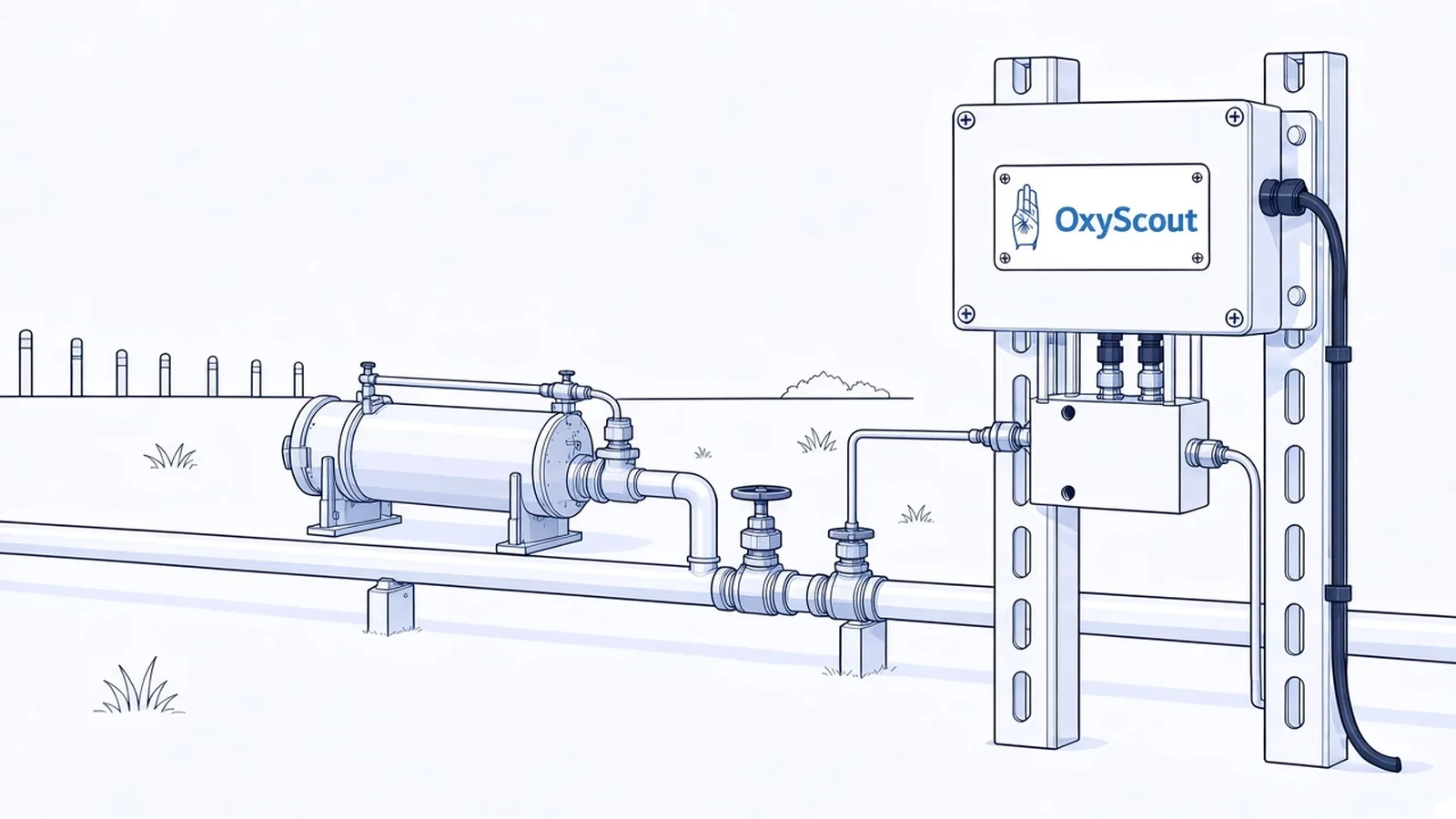
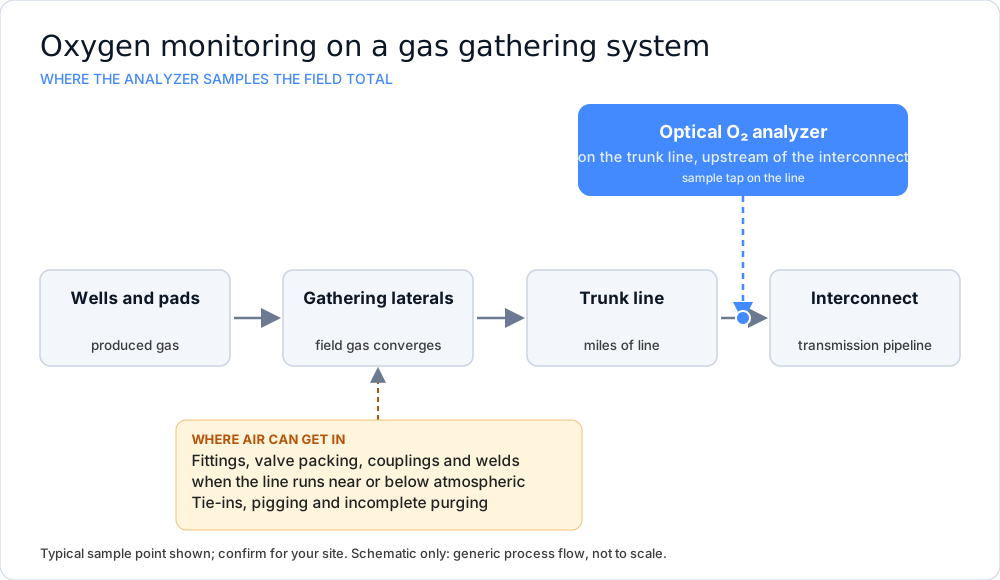
A gathering system collects gas from many wells and carries it to treating and sales. Oxygen in that stream is air drawn in at the surface, because produced gas starts essentially oxygen-free. When low-pressure or vacuum systems pull on declining wells, every fitting, valve packing gland, coupling, gasket and porous weld on buried line becomes a path for air.
The analyzer reads the converged stream on the trunk line, just upstream of the interconnect. There you see the field's total oxygen before custody transfer, including air that entered along the line itself. A sample tap off the gathering header or trunk feeds the analyzer.
Wellhead monitoring finds the one well that is leaking. Gathering-line monitoring shows the total that reaches the interconnect, including leaks along the line that no wellhead analyzer can see. They answer different questions, and a system can use both.
Pressure above atmospheric does not fully prevent this. The guide explains why, because oxygen can diffuse back through a leak against line pressure.
Measurement is continuous and there is no electrochemical cell to deplete, so there is no scheduled cell swap at a remote tap. OxyScout has no cross-sensitivity to H₂S or CO₂, which matters on wet, sour gathering gas.
| Pressure | Up to 250 PSI input pressure† |
|---|---|
| Humidity | The analyzer is specified for non-condensing conditions, so use the sample-system filter on wet gas. |
| Ranges | The Ultra-Trace range is 0–50 ppm, Trace range is 0–1000 ppm and the Percent ranges are 0–1 %, 0–10 % and 0–21 % by volume. |
| Detection limit* | The limit of detection is ≤ 0.5 ppm O₂ on the Ultra-Trace range (0–50 ppm), 50 ppm O₂ on the Trace range (0–1000 ppm), 0.01 %vol O₂ on the Percent 0–1 %vol range and 0.1 %vol O₂ on the Percent 0–10 % and 0–21 %vol ranges. |
| Accuracy* | Accuracy is ±2 ppm or ±5% of reading, whichever is greater, on the Ultra-Trace range (0–50 ppm). Accuracy is ±0.5% of full scale on the 0–1 %vol Percent range, and ±5% of full scale on the Trace range (0–1000 ppm) and the 0–10 % and 0–21 %vol ranges. |
| Response time* | Typical response time is under 10 seconds. |
| Outputs | The outputs are a 4–20 mA loop (current sink) and RS-485 Modbus RTU (2-wire half-duplex). |
| Environment | Process and ambient temperature is 0 to 50 °C, the enclosure is IP67, and extreme-heat or extreme-cold enclosures are available. |
*Based on controlled lab conditions.
†Without Flowmeter installed. Higher ratings if regulator installed upstream.
Wellhead monitors find the individual source. The gathering line is where all sources converge, so a trunk-line analyzer shows the total the interconnect will see, including leaks along the line itself.
The analyzer typically samples from the trunk line upstream of the interconnect, so that it reads the field total.
One on the trunk line shows the total. More points, such as on laterals or at key tie-ins, help localize the source.
Bring the line pressure and where the interconnect limit is measured. We will review the tap and send a quote.
Get a Quote