
Worn rod packing and shaft seals can let air into a compressor that pulls on a low-pressure source, and the compressor then pushes that air toward the sales meter. An optical oxygen analyzer on the discharge line reads what the station actually delivers, continuously.
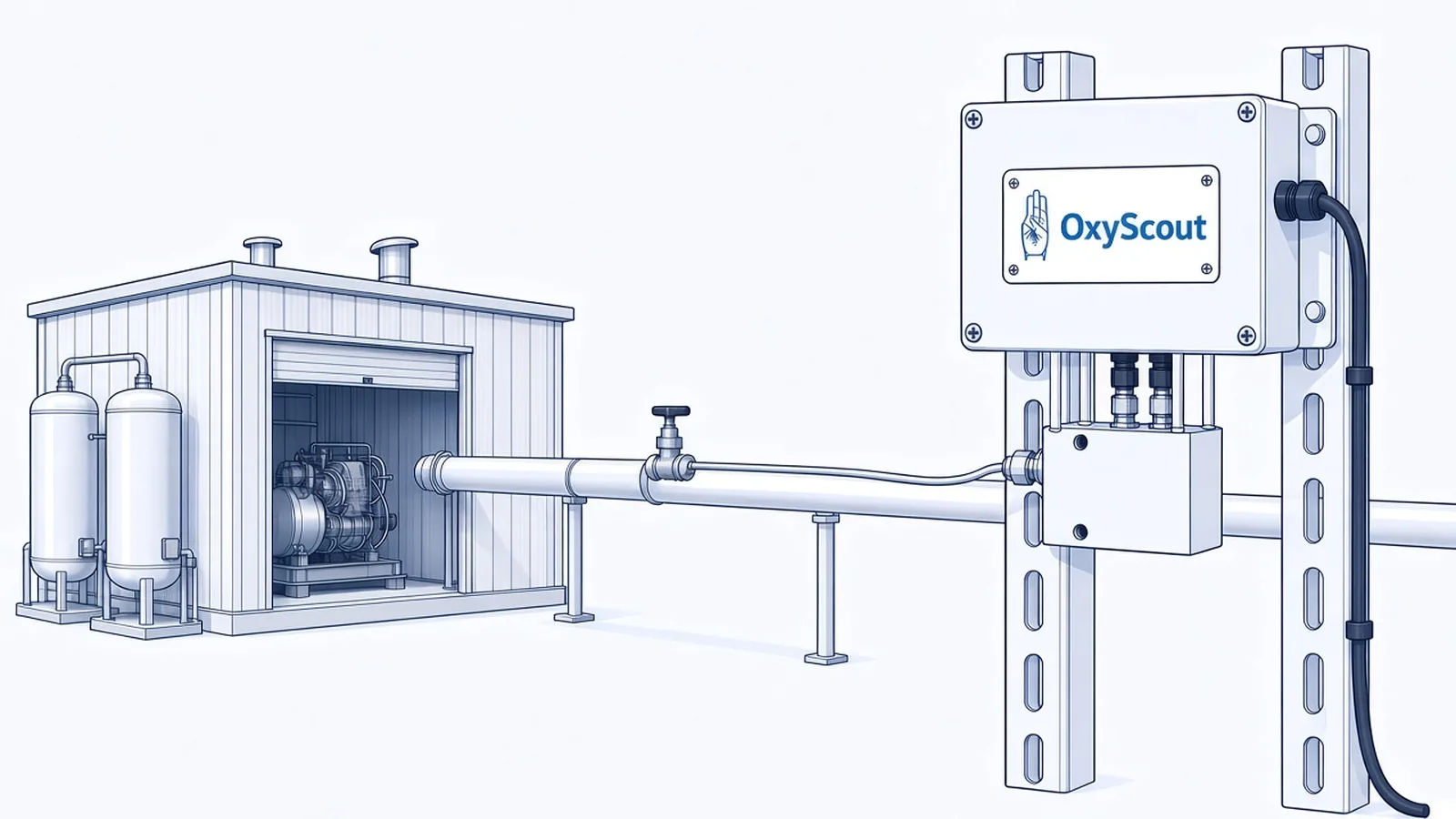
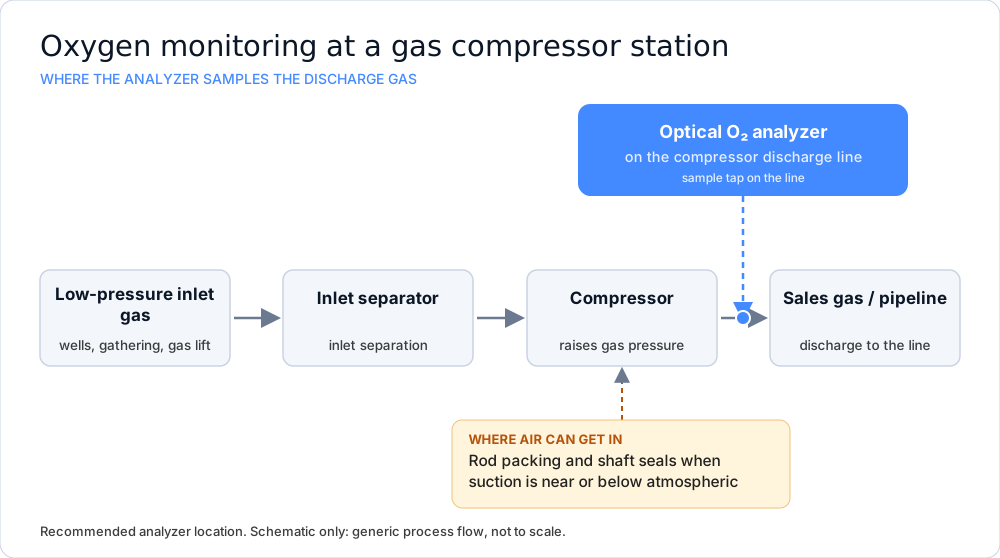
A station boosts gas from wells and gathering lines to pipeline pressure. When the source declines and suction falls near or below atmospheric, a worn rod packing or shaft seal becomes a path for air, and the compressor sends that oxygen downstream with the gas. One machine can be the whole source, which makes a station a good place to look.
Positive suction pressure does not rule it out. Oxygen's partial pressure in air is far higher than in the gas, so it can diffuse back through a leak even when line pressure is above ambient. Sub-atmospheric suction simply makes it worse.
The analyzer mounts on the compressor discharge line so that it can detect air leaks, such as seal failures, that introduce O₂ into the gas stream. The discharge carries the combined result of everything on the suction side, so the reading is what your pipeline and downstream equipment will see.
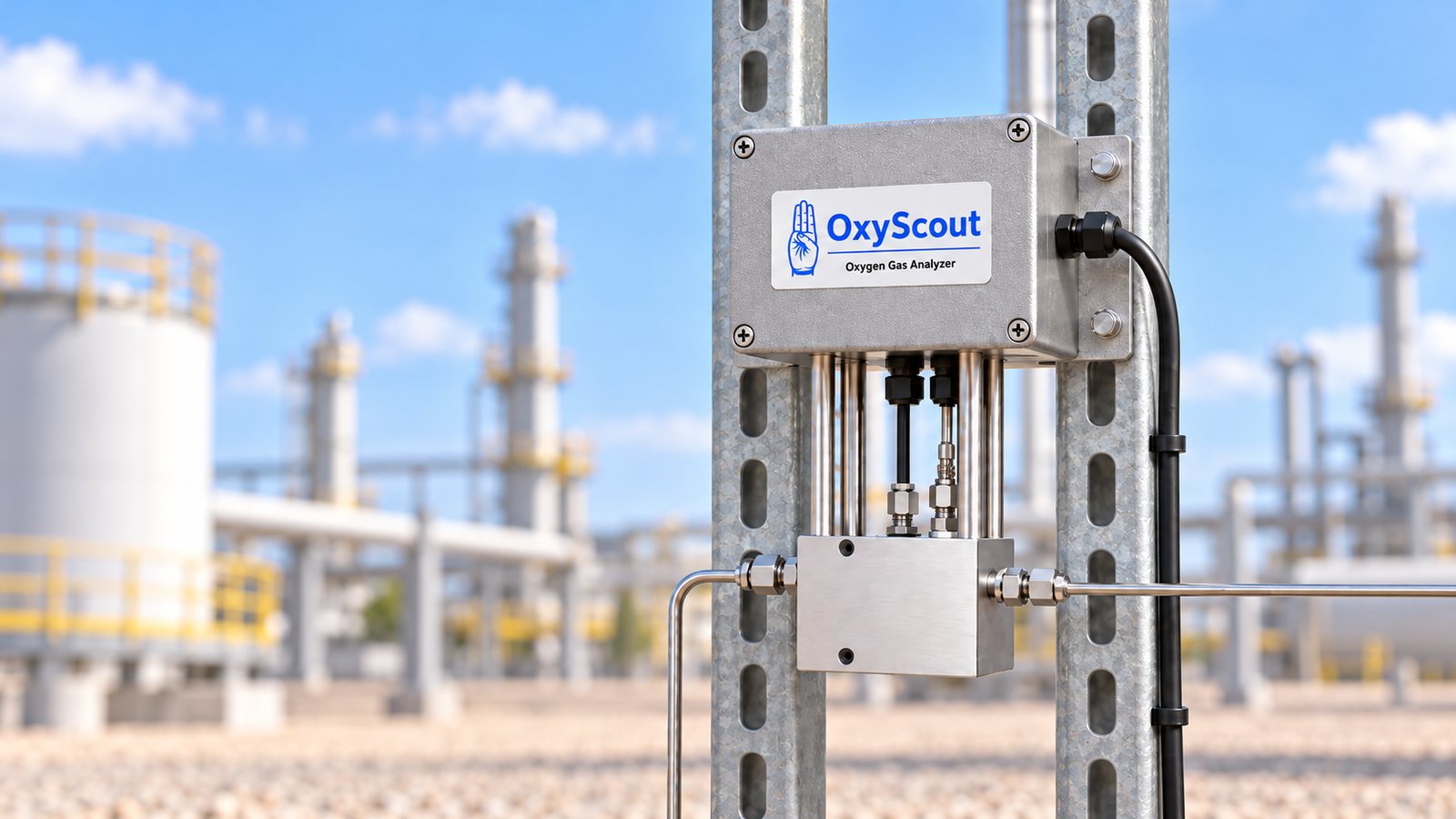
One analyzer on a common discharge gives the station total. To find which machine is leaking, you need more points, for example on individual units or on both sides of a suspect compressor. Start with the total, and then add points where the reading says to.
Without the optional flowmeter installed, the analyzer is rated up to 250 psi. Discharge pressure at your station may be higher than that, and higher ratings are available if a regulator is installed upstream. The optional sample system adds a pressure regulator and gauge, a secondary filter and a 3-way valve for calibration gas or process sample.
The analyzer is specified for non-condensing conditions, so on wet field gas plan the sample point and the secondary filter so liquids stay out of it.
Remote stations are expensive to visit, and a measuring cell that is consumed by the measurement sets a visit schedule. The optical analyzer has no such cell. Typical response time is under 10 seconds,* and OxyScout has no cross-sensitivity to H₂S or CO₂, which matters on sour field gas.
Oxygen that reaches downstream treating can degrade glycol and amine chemistry and speed corrosion, which is why catching it at the station helps keep it from travelling.
| Pressure | Up to 250 PSI input pressure† |
|---|---|
| Ranges | The 0–50 ppm and 0–1000 ppm ranges suit comparison against a tariff limit, and the 0–1 %, 0–10 % and 0–21 % ranges suit upsets and larger leaks. |
| Detection limit* | The limit of detection is ≤ 0.5 ppm O₂ on the Ultra-Trace range (0–50 ppm), 50 ppm O₂ on the Trace range (0–1000 ppm), 0.01 %vol O₂ on the Percent 0–1 %vol range and 0.1 %vol O₂ on the Percent 0–10 % and 0–21 %vol ranges. |
| Accuracy* | Accuracy is ±2 ppm or ±5% of reading, whichever is greater, on the Ultra-Trace range (0–50 ppm). Accuracy is ±0.5% of full scale on the 0–1 %vol Percent range, and ±5% of full scale on the Trace range (0–1000 ppm) and the 0–10 % and 0–21 %vol ranges. |
| Response time* | Typical response time is under 10 seconds. |
| Outputs | The outputs are a 4–20 mA loop (current sink) and RS-485 Modbus RTU (2-wire half-duplex). |
| Power | The analyzer runs on 9–36 VDC and draws 35 mA plus the current used by its analog outputs. |
| Environment | Process and ambient temperature is 0 to 50 °C, the enclosure is IP67, and extreme-heat or extreme-cold enclosures are available for direct sun or freezing conditions. |
| Area classification | The analyzer is engineered for Class 1 Division 2 (Zone 2) hazardous areas. |
*Based on controlled lab conditions.
†Without Flowmeter installed. Higher ratings if regulator installed upstream.
Put the analyzer on the compressor discharge line. There it reads the gas the station delivers, including air drawn in anywhere on the suction side or through the packing.
You set the alarm point in your RTU, PLC or SCADA from the 4–20 mA or Modbus signal. A rise points you to packing and seals first, then to the suction-side sources feeding the station.
OxyScout has no cross-sensitivity or poisoning from H₂S or CO₂. The analyzer is specified for non-condensing conditions, so wet gas needs the sample-system filter and drain considered.
No, you do not need one on every compressor. One analyzer on a common discharge shows the station total, and extra points narrow a leak to one machine.
Bring the discharge pressure and the number of compressors. We will go through placement and sampling and send a quote.
Get a Quote