

OxyScout by Standard Sensors is an optical oxygen analyzer for continuous trace and percent-level O₂ measurement in natural gas. The analyzer has no electrochemical cells to replace and no cross-sensitivity to H₂S or CO₂, and it is priced comparably to electrochemical analyzers.
An optical oxygen analyzer measures oxygen with a fully optical sensor rather than an electrochemical (galvanic) cell. OxyScout reads trace (ppm) and percent-level O₂ continuously in natural gas and other oil & gas process streams, and sends the result as 4–20 mA or RS-485 Modbus RTU.
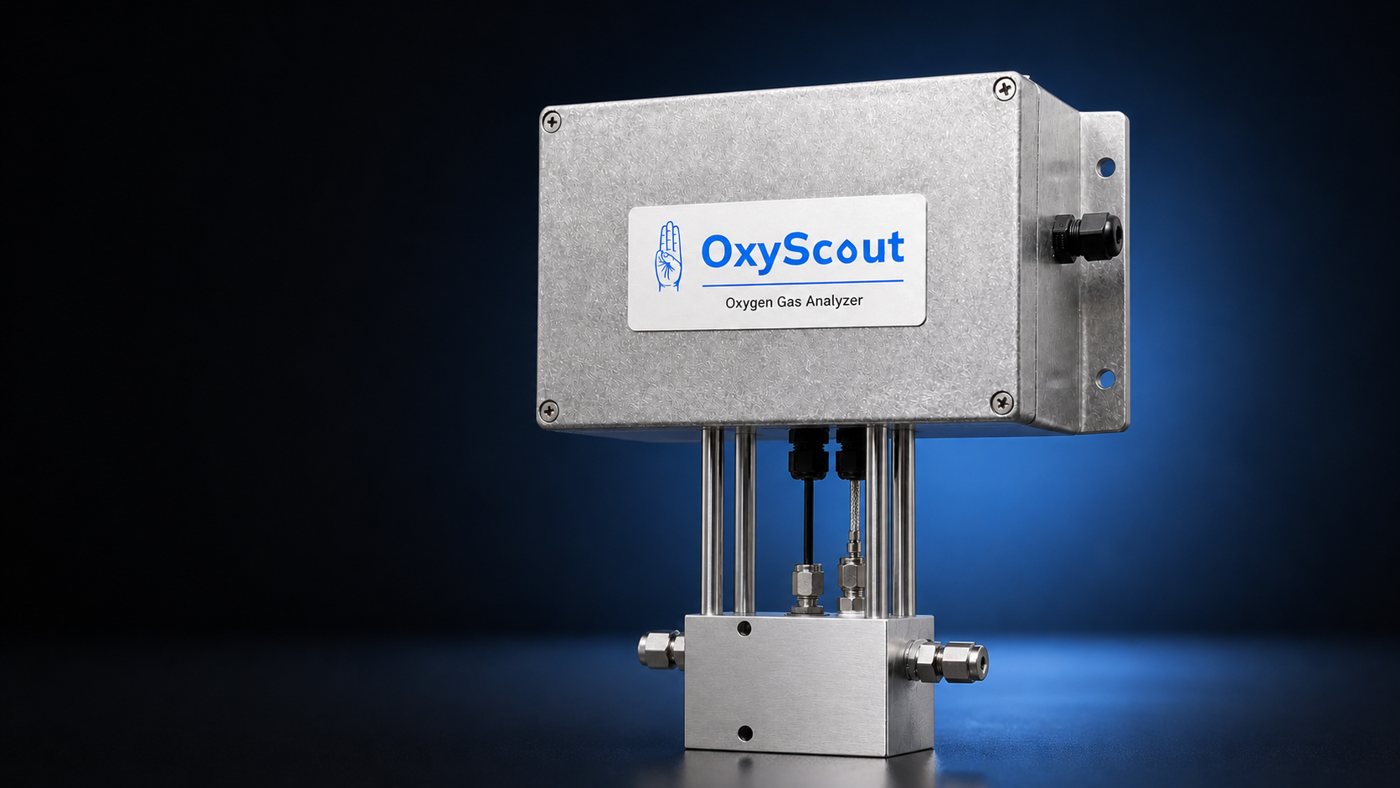
A trace oxygen analyzer reports oxygen in parts per million (ppm), and a percent oxygen analyzer reports oxygen in percent by volume (%vol). One percent by volume equals 10,000 ppm. OxyScout Ultra-Trace and OxyScout Trace are the trace models, and OxyScout Percent is the percent model. All three models share the same installation, wiring, firmware and communications, and they differ in measuring range and calibration.
| Model | Measuring range* | Detection limit* | Accuracy* | Typical application |
|---|---|---|---|---|
| OxyScout Ultra-Trace | 0–50 ppm O₂ | ≤0.5 ppm O₂ | ±2 ppm or ±5% of reading, whichever is greater | Sales gas, custody transfer and vapor recovery units with a low-ppm specification |
| OxyScout Trace | 0–1,000 ppm O₂ | 50 ppm O₂ | Typically ±2% of reading or ±0.01% O₂ (100 ppm), whichever is greater | Gathering, vapor recovery units and process |
| OxyScout Percent | 0–1, 0–10 or 0–21 %vol O₂, user-selected | 0.005% O₂ (50 ppm) | Typically ±2% of reading or ±0.01% O₂ (100 ppm), whichever is greater | High-level and air-range service, including tank blanketing |
*Based on controlled lab conditions.
Choose a range that puts your oxygen limit well inside the scale, with enough headroom above the limit to see an upset rather than a pegged signal. The pipeline oxygen limits guide matches published limits to each range.
OxyScout combines a proprietary optical sensor, the ZeroLeak™ Cell Block and standard industrial outputs in one analyzer for natural gas service. All three models include the ZeroLeak™ Cell Block.
OxyScout measures oxygen with a proprietary optical sensor instead of an electrochemical (galvanic) cell. The measurement consumes nothing, and there is no electrolyte to deplete, dry out or leak.
OxyScout has no cross-sensitivity or poisoning from H₂S, CO₂ or the other gases that plague galvanic cells.
Analyzers that need a set sample flow rely on an upstream flowmeter and needle valve to hold it. OxyScout's optical reading does not depend on sample flow rate, so no upstream flowmeter or needle valve is needed, and the optional flowmeter mounts at the vent only to limit venting to atmosphere. Fewer parts mean fewer things that can fail, and with the ZeroLeak™ Cell Block, fewer parts in the flow path mean fewer leak points.
Every model has a 4–20 mA output and RS-485 Modbus RTU for your RTU, PLC or SCADA system, and both outputs work at the same time. ScoutView, the OxyScout configuration software, ships with every analyzer.
OxyScout is engineered for Class 1 Division 2 (Zone 2) hazardous areas. The IP67 enclosure works at 0 to 50 °C*, and extreme-heat and extreme-cold enclosure options are available.
The initial purchase price of OxyScout is similar to an electrochemical O₂ analyzer, but the total cost of ownership over 2–3 years is much lower. With no electrochemical cells to replace, there are no cell changes to schedule.
*Based on controlled lab conditions.
The ZeroLeak™ Cell Block is the machined block below the analyzer enclosure. The cell block is machined out of one solid block of 6061-T6 aluminum with an electroless nickel plating finish, so minimal fittings are required and there are minimal places for a leak. Because the optical measurement is independent of flow rate, the sample line needs no upstream flowmeter or needle valve, which leaves fewer components between the process tap and the cell block. With fewer components in the flow path, there are fewer joints that could leak and fewer parts that could fail. Sample conditioning is minimal, and an optional sample system is available.
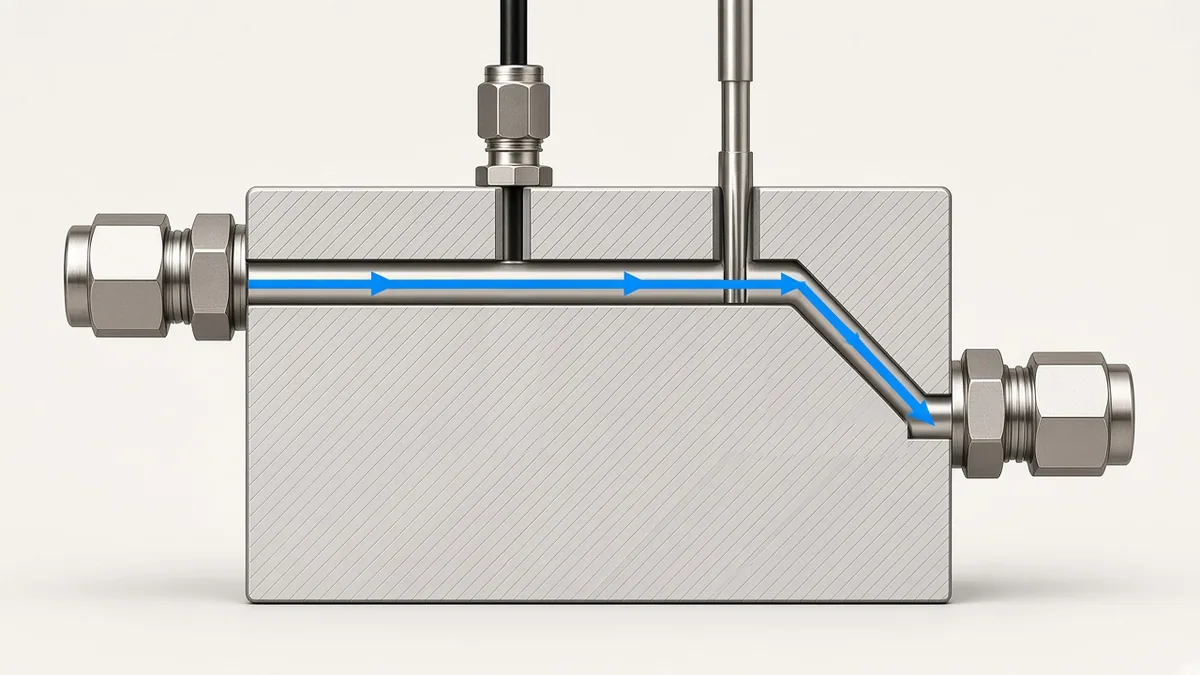 Sample inSample outFiber optic cableRTD temperature probe
The cell block is machined out of one solid block of 6061-T6 aluminum and finished with electroless nickel plating.
Because the flow path is machined into a single block, minimal fittings are required and there are minimal places for a leak.
The flow path has zero dead legs and minimal internal volume, so there is less sample lag and a faster response time.
Zero dead legs and minimal internal volume also allow a rapid, full purge of the flow path.
The sample bore slopes down from the inlet on the left to the outlet on the right, so any moisture buildup drains out instead of stagnating in the cell block.
The analyzer covers trace and percent-level oxygen with 4–20 mA and Modbus outputs, runs on 9–36 VDC, and is engineered for Class 1 Division 2 (Zone 2) areas. These are typical specifications, and the pressure rating applies without the optional flowmeter installed.
| Measurement | The analyzer uses a fully optical O₂ sensor, so there are no electrochemical cells to replace. |
|---|---|
| Ranges | The Ultra-Trace range is 0–50 ppm, Trace range is 0–1000 ppm and the Percent ranges are 0–1 %, 0–10 % and 0–21 % by volume. |
| Outputs | The outputs are a 4–20 mA loop (current sink) and RS-485 Modbus RTU (2-wire half-duplex). |
| Power | The analyzer runs on 9–36 VDC and draws 35 mA plus the current used by its analog outputs. |
| Process / ambient temperature | Process and ambient temperature is 0 to 50 °C, and storage temperature is −20 to 70 °C. |
| Pressure | Up to 250 PSI input pressure† |
| Humidity / flow | The analyzer is specified for non-condensing conditions, and it has no flow restrictions. |
| Area classification | The analyzer is engineered for Class 1 Division 2 (Zone 2) hazardous areas. |
| Size / weight | The enclosure is 9 in high, 7 in wide and 2.5 in deep, and the analyzer weighs 4 lb. |
| Process connection | The process connection is 1/8 in tube compression. |
| Options | The options include a flowmeter to regulate vent flow to atmosphere if required, a sample system (pressure regulator and gauge, secondary filter, and a 3-way valve for calibration gas or process sample), and an extreme-heat or extreme-cold enclosure. |
| Response time* | Typical response time is under 10 seconds. |
| Detection limit* | The limit of detection is ≤0.5 ppm O₂ on OxyScout Ultra-Trace (0–50 ppm), 50 ppm O₂ on OxyScout Trace (0–1,000 ppm) and 0.005% O₂ (50 ppm) on OxyScout Percent (0–1, 0–10 and 0–21 %vol). |
| Accuracy* | Accuracy is ±2 ppm or ±5% of reading, whichever is greater on OxyScout Ultra-Trace. On OxyScout Trace and on all OxyScout Percent ranges, accuracy is typically ±2% of reading or ±0.01% O₂ (100 ppm), whichever is greater. |
| Resolution* | Resolution on OxyScout Trace and OxyScout Percent is 0.002% O₂ at 0.2% O₂. |
*Based on controlled lab conditions. Standard Sensors Corporation reserves the right to make revisions and/or changes without notice.
†Without Flowmeter installed. Higher ratings if regulator installed upstream.
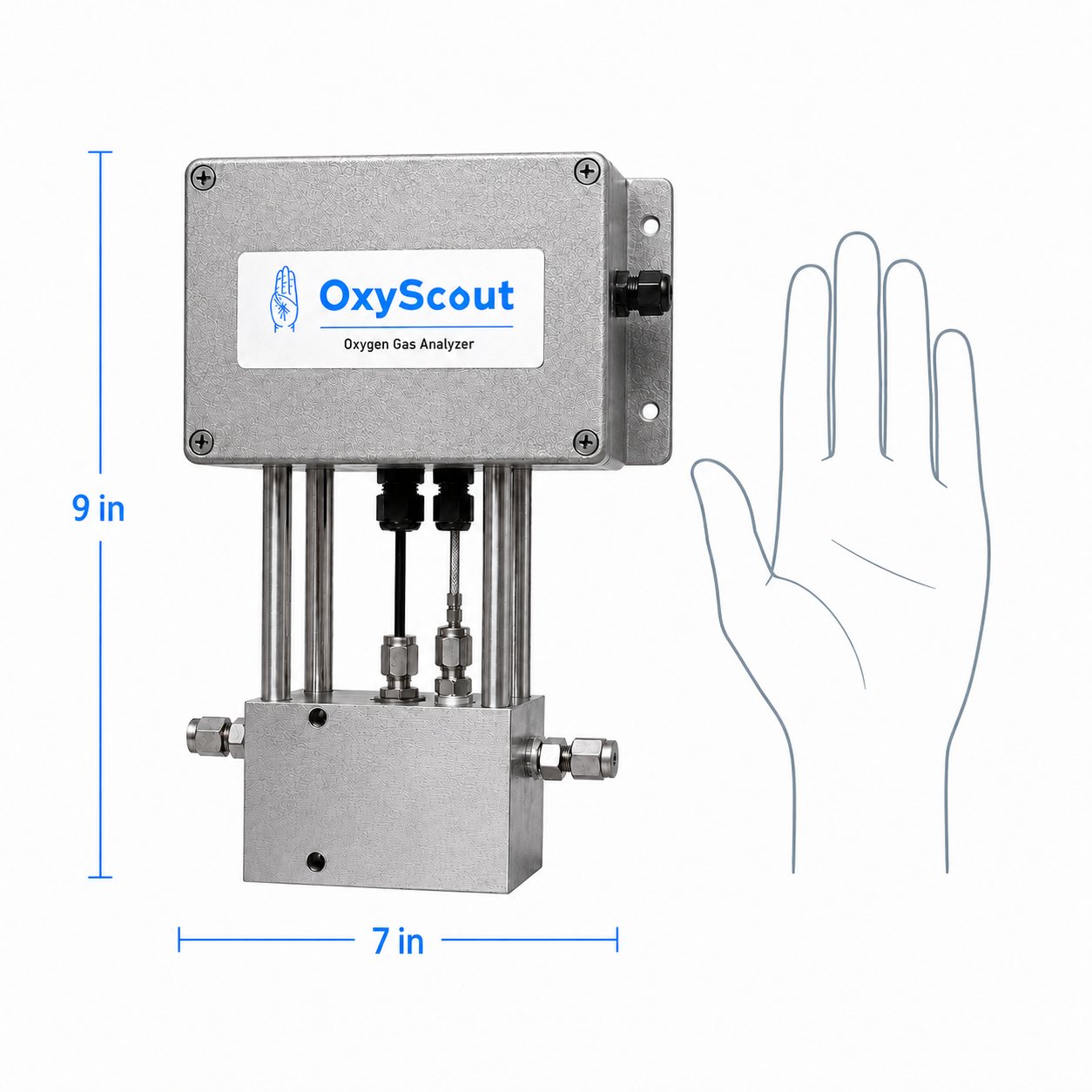
The sample tap uses 1/8 in tube compression. The analyzer measures 9 × 7 × 2.5 in, weighs 4 lb and runs on 9–36 VDC at 35 mA plus the current used by its analog outputs. Wire the 4–20 mA loop or RS-485 Modbus RTU to your RTU, PLC or SCADA, and set your own alarm points.
Without the optional flowmeter installed, the analyzer is rated up to 250 psi. Higher ratings are available if a regulator is installed upstream. The optional sample system adds a pressure regulator and gauge, a secondary filter and a 3-way valve for calibration gas or process sample.
| Electrochemical (galvanic) cell | Optical (OxyScout) | |
|---|---|---|
| What wears out | The cell itself wears out and is replaced on a schedule. | No electrochemical cell has to be replaced. |
| H₂S, CO₂ and other gases | These gases can affect the cell. | OxyScout has no cross-sensitivity or poisoning. |
| Outputs | The outputs vary by model. | The outputs are 4–20 mA and RS-485 Modbus RTU. |
| Price positioning | The initial purchase price is similar to OxyScout. | OxyScout is priced comparably to electrochemical analyzers. |
For the full comparison, including the cost-of-ownership components to add up, read optical vs electrochemical oxygen analyzers.





An optical oxygen analyzer measures oxygen (O₂) in a gas sample, continuously, with a fully optical sensor. OxyScout covers trace ranges of 0–50 ppm and 0–1000 ppm by volume and percent ranges of 0–1 %, 0–10 % and 0–21 % by volume.
OxyScout Trace reads 0–1,000 ppm O₂ with a 50 ppm detection limit, and OxyScout Percent reads 0–1, 0–10 or 0–21 %vol O₂ with a 0.005% O₂ (50 ppm) detection limit.*
The outputs are a 4–20 mA loop (current sink) and RS-485 Modbus RTU (2-wire half-duplex). Power is 9–36 VDC with a 35 mA draw plus the current used by the analog outputs.
The analyzer is engineered for Class 1 Division 2 (Zone 2) hazardous areas and has an IP67 enclosure. Process and ambient temperature is 0 to 50 °C. The analyzer is rated up to 250 psi without the flowmeter installed. Higher ratings are available if a regulator is installed upstream. Extreme-heat and extreme-cold enclosures are available.
Typical response time is under 10 seconds.* The limit of detection is ≤0.5 ppm O₂ on OxyScout Ultra-Trace, 50 ppm O₂ on OxyScout Trace and 0.005% O₂ (50 ppm) on OxyScout Percent.* *Based on controlled lab conditions.
OxyScout has no cross-sensitivity or poisoning from H₂S, CO₂ or the other gases that plague galvanic cells.
Book a free 30-minute online meeting to review your application, range and quantities, then we send a quote. You can also call (936) 259-4643 or email [email protected].
Book a 30-minute meeting to review your application and we'll send you a quote after the call.
Get a Quote