
A blanketed tank is supposed to keep air out, and an optical oxygen analyzer on the tank vapor line tells you whether it does. Rising oxygen means the blanket has failed or air is getting in, and you learn that before it becomes a safety or emissions problem.
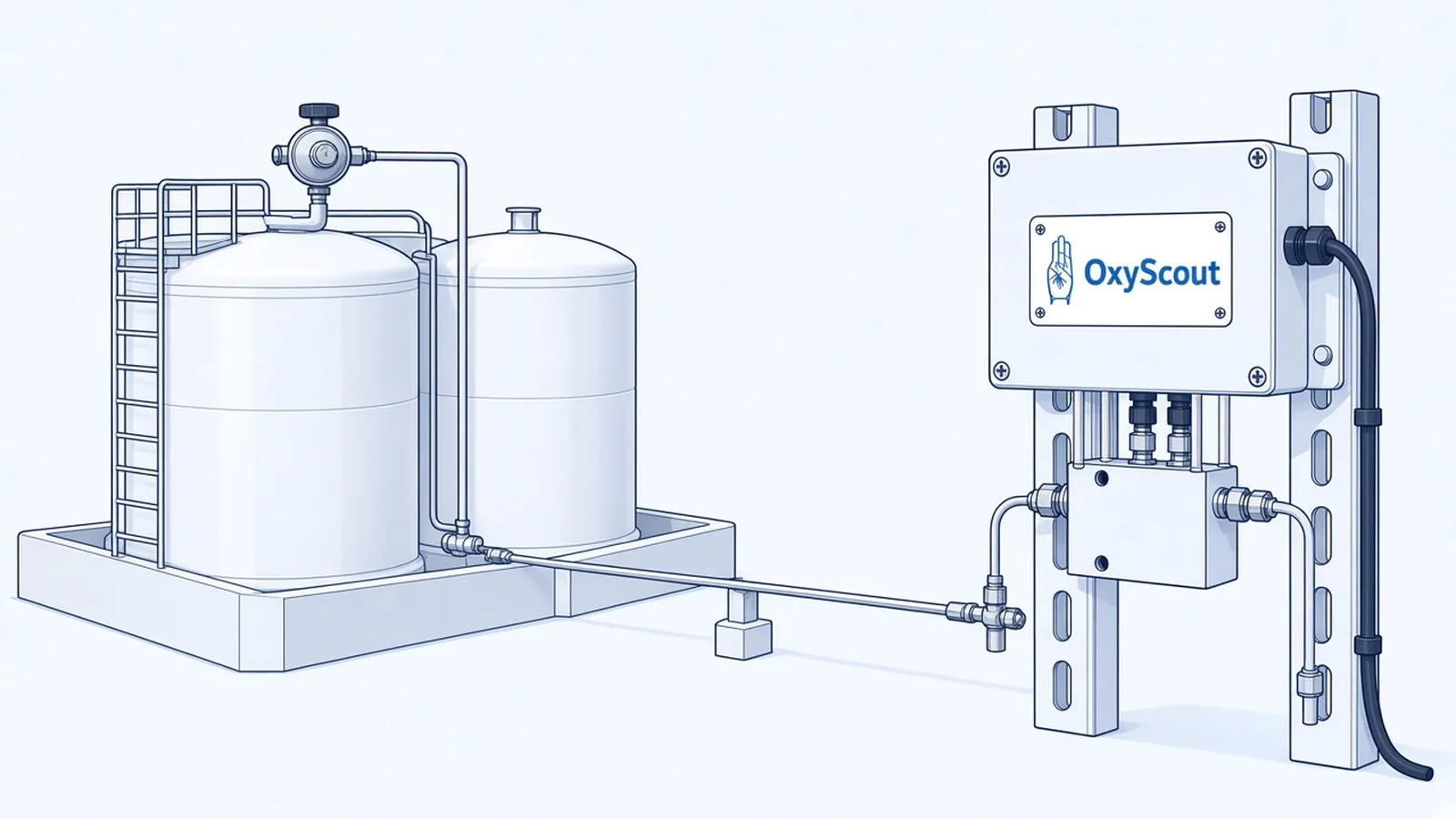
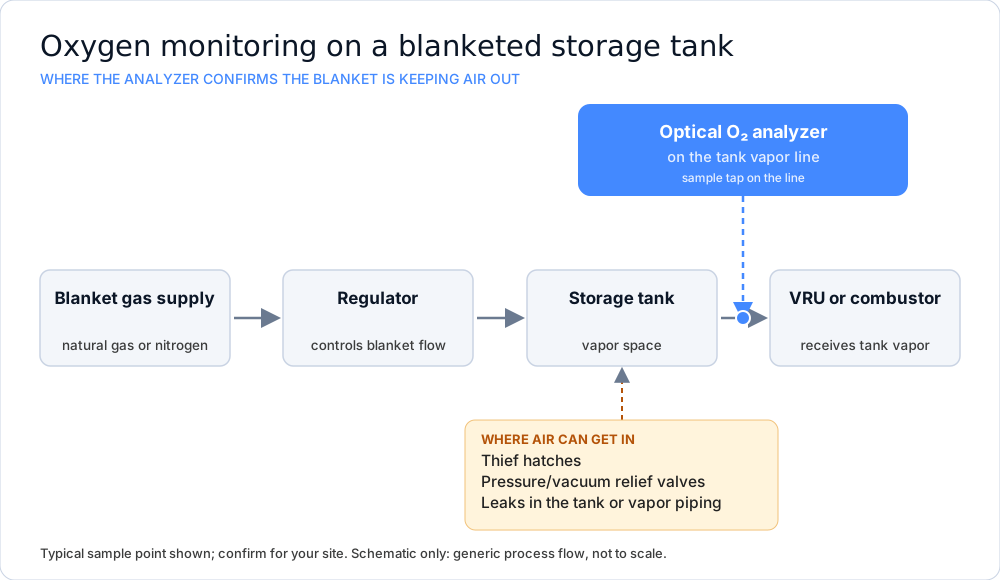
Storage tanks are often blanketed with natural gas or nitrogen so the vapor space stays free of air. The weak point is knowing the blanket is working. If supply or regulation fails, or air gets in elsewhere, the vapor space slowly fills with oxygen and nothing alerts you. An oxygen reading answers the question directly.
This differs from the VRU case. On a VRU the question is how much air the recovery equipment pulls in. On a blanketed tank it is whether the blanket keeps air out in the first place.
The analyzer mounts on the tank vapor line, so it sees the gas leaving the vapor space on its way to a VRU or combustor. That reading reflects the vapor space itself.
A rising reading means the blanket has failed or air is entering. The analyzer shows that oxygen is rising and when, but not which of the four causes it is. Use the trend together with checks of hatches, relief valves, regulator and supply, and protect the VRU or combustor that receives the vapor.
| Ranges | The percent-level ranges (0–1 %, 0–10 % and 0–21 % by volume) usually fit, but you should choose the range from the oxygen levels you need to detect. |
|---|---|
| Detection limit* | The limit of detection is ≤ 0.5 ppm O₂ on the Ultra-Trace range (0–50 ppm), 50 ppm O₂ on the Trace range (0–1000 ppm), 0.01 %vol O₂ on the Percent 0–1 %vol range and 0.1 %vol O₂ on the Percent 0–10 % and 0–21 %vol ranges. |
| Accuracy* | Accuracy is ±2 ppm or ±5% of reading, whichever is greater, on the Ultra-Trace range (0–50 ppm). Accuracy is ±0.5% of full scale on the 0–1 %vol Percent range, and ±5% of full scale on the Trace range (0–1000 ppm) and the 0–10 % and 0–21 %vol ranges. |
| Response time* | Typical response time is under 10 seconds. |
| Gas condition | The gas should be non-condensing. The analyzer is rated up to 250 psi without the flowmeter installed. Higher ratings are available if a regulator is installed upstream. Regulator, filter and flowmeter options are available. |
| Area classification | The analyzer is engineered for Class 1 Division 2 (Zone 2) hazardous areas, and the IP67 enclosure protects against dust and water. |
| Outputs | The outputs are a 4–20 mA loop (current sink) and RS-485 Modbus RTU (2-wire half-duplex). |
*Based on controlled lab conditions.
Tank vapor can carry H₂S and CO₂. OxyScout has no cross-sensitivity to either and no poisoning of the optical sensor, and there is no electrochemical cell to replace.
Yes. Storage tanks are blanketed with natural gas or nitrogen to keep air out of the vapor space, and the oxygen reading tells you whether either one is working.
The percent-level ranges (0–1 %, 0–10 % and 0–21 %) usually fit, but choose based on the oxygen levels you need to detect.
No. The signal shows that oxygen is rising. Use the trend with checks of hatches, relief valves, regulator and supply to find the cause.
On a VRU the question is how much air the recovery equipment pulls in. On a blanketed tank it is whether the blanket keeps air out of the vapor space. See vapor recovery units.
Bring the blanket gas, the alarm level and where the vapor goes next. We will review it and send a quote.
Get a Quote