
At the wellhead, oxygen is still undiluted and traceable to one well. An optical oxygen analyzer on produced gas at the wellhead or production separator turns a field-wide spec problem into a single work order, on low-pressure, plunger-lift and stripper wells that are costly to visit.
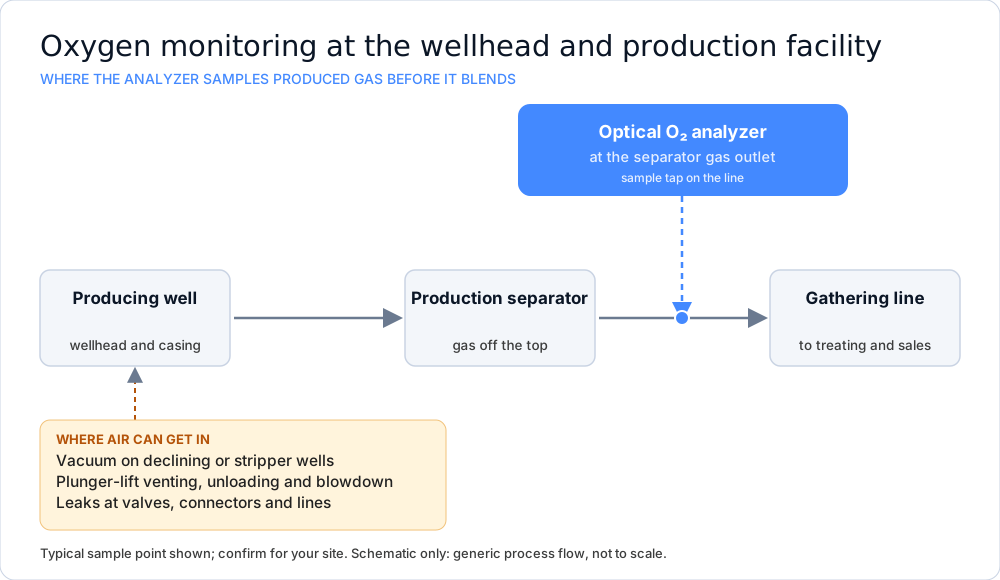
Produced gas leaves the reservoir essentially oxygen-free, so oxygen in it is air that got in at the surface, and the wellhead is the earliest place that can happen. As a well declines, wellhead and casing pressure can fall to near or below atmospheric, and any leak path becomes a way in for air.
Marginal and stripper wells run with the least maintenance and the lowest pressure, so they are the likeliest sources. They are also the hardest to find later, once their gas has mixed into a common gathering line.
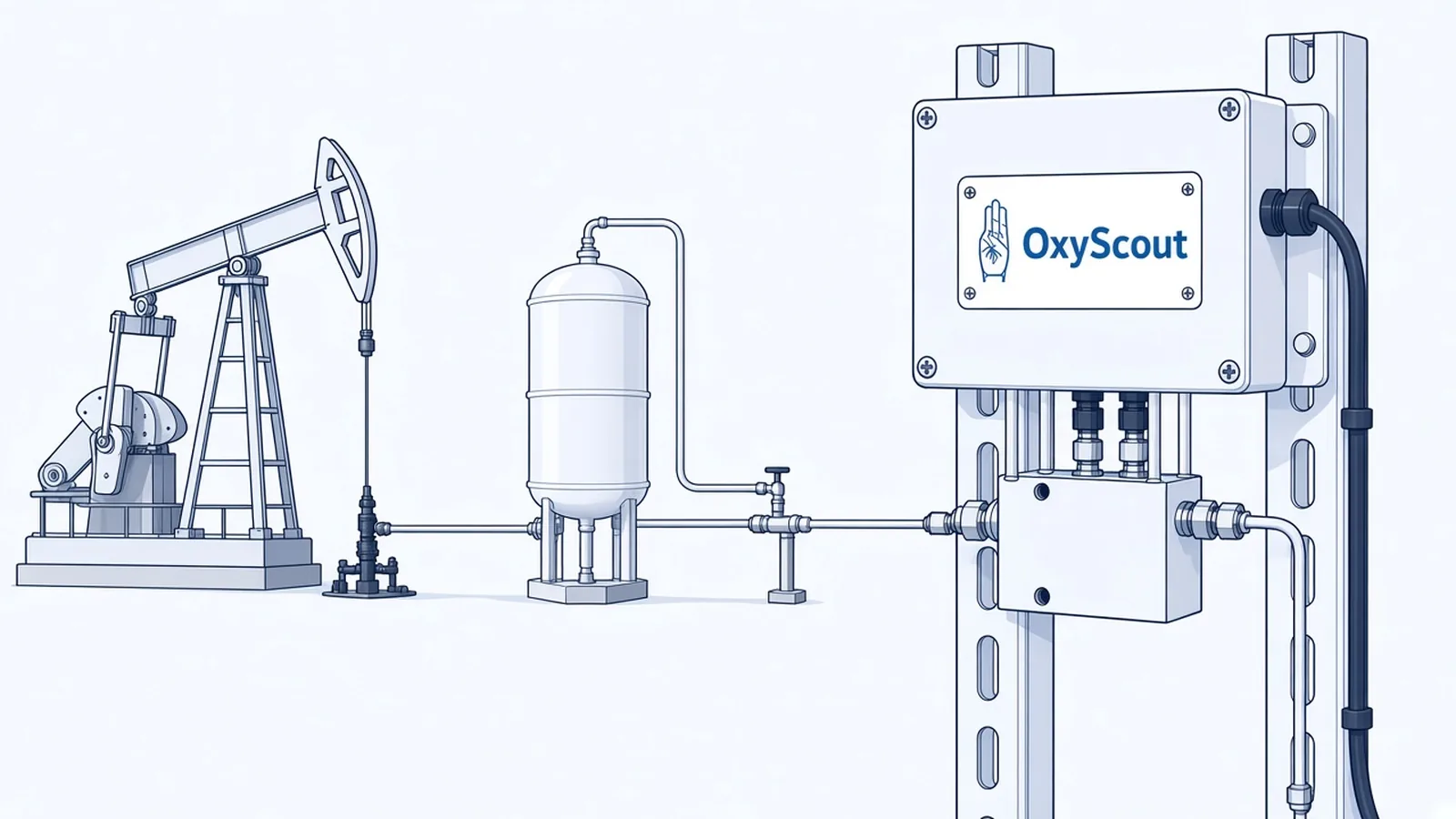
The analyzer samples at the wellhead or at the production separator gas outlet, before the gas blends with other wells. The reading there is undiluted and tied to one well or one pad, so you know where to send the crew.
Dilution hides a leaking well. As illustrative arithmetic, not a field measurement: if one well makes gas at 1 % oxygen (10,000 ppm) and supplies 5 % of the gathered volume, the blended stream carries about 0.05 % (500 ppm). That is far below the well's own reading, and it is hard to trace once mixed.
Left alone, oxygen speeds internal corrosion of carbon-steel gathering lines, can feed microbially influenced corrosion, and can put gas over the pipeline limit at the interconnect, which means shut-in production and lost revenue.
A remote pad has few people and limited power. The analyzer runs on 9–36 VDC and draws 35 mA plus the current used by its analog outputs. For direct sun or freezing conditions an extreme-heat or extreme-cold enclosure is available. The enclosure is IP67, and the analyzer is engineered for Class 1 Division 2 (Zone 2) hazardous areas.
With no electrochemical cell, there is no cell swap to drive out to the pad for.
The process connection is 1/8 in tube compression, and an optional flowmeter regulates vent flow to atmosphere if required. The sample system adds a pressure regulator and gauge, a secondary filter and a 3-way valve for calibration gas or process sample. Wellhead gas can be wet, and the analyzer is specified for non-condensing conditions, so plan the sample point and the optional secondary filter to keep liquids out.
| Power | The analyzer runs on 9–36 VDC and draws 35 mA plus the current used by its analog outputs. |
|---|---|
| Ranges | The Ultra-Trace range is 0–50 ppm, Trace range is 0–1000 ppm and the Percent ranges are 0–1 %, 0–10 % and 0–21 % by volume. |
| Detection limit* | The limit of detection is ≤ 0.5 ppm O₂ on the Ultra-Trace range (0–50 ppm), 50 ppm O₂ on the Trace range (0–1000 ppm), 0.01 %vol O₂ on the Percent 0–1 %vol range and 0.1 %vol O₂ on the Percent 0–10 % and 0–21 %vol ranges. |
| Accuracy* | Accuracy is ±2 ppm or ±5% of reading, whichever is greater, on the Ultra-Trace range (0–50 ppm). Accuracy is ±0.5% of full scale on the 0–1 %vol Percent range, and ±5% of full scale on the Trace range (0–1000 ppm) and the 0–10 % and 0–21 %vol ranges. |
| Response time* | Typical response time is under 10 seconds. |
| Pressure | Up to 250 PSI input pressure† |
| Humidity | The analyzer is specified for non-condensing conditions. |
| Environment | Process and ambient temperature is 0 to 50 °C, the enclosure is IP67, and extreme-heat or extreme-cold enclosures are available. |
| Outputs | The outputs are a 4–20 mA loop (current sink) and RS-485 Modbus RTU (2-wire half-duplex). |
| Size / weight | The enclosure is 9 in high, 7 in wide and 2.5 in deep, and the analyzer weighs 4 lb. |
*Based on controlled lab conditions.
†Without Flowmeter installed. Higher ratings if regulator installed upstream.
Marginal and stripper wells are the most likely, because they run at low pressure with the least maintenance. A well on vacuum draws air in through any worn valve stem, open-ended line or corroded connector.
You do not always need one. A pad-level or separator-level analyzer shows which pad is the source, and one at the well itself shows which well.
The analyzer is specified for non-condensing conditions. On wet gas, plan the sample point and the optional secondary filter so liquids do not reach the analyzer.
OxyScout does not need AC power. The analyzer runs on 9–36 VDC and draws 35 mA plus the current used by its analog outputs.
Bring the pressure, moisture and power you have at the pad. We will go through the sample point and send a quote.
Get a Quote