
Air in a flare header can create a flammable mixture inside the piping. An optical oxygen analyzer on the header gives you a continuous signal that purge flow is keeping air out, and an early warning when it is not.
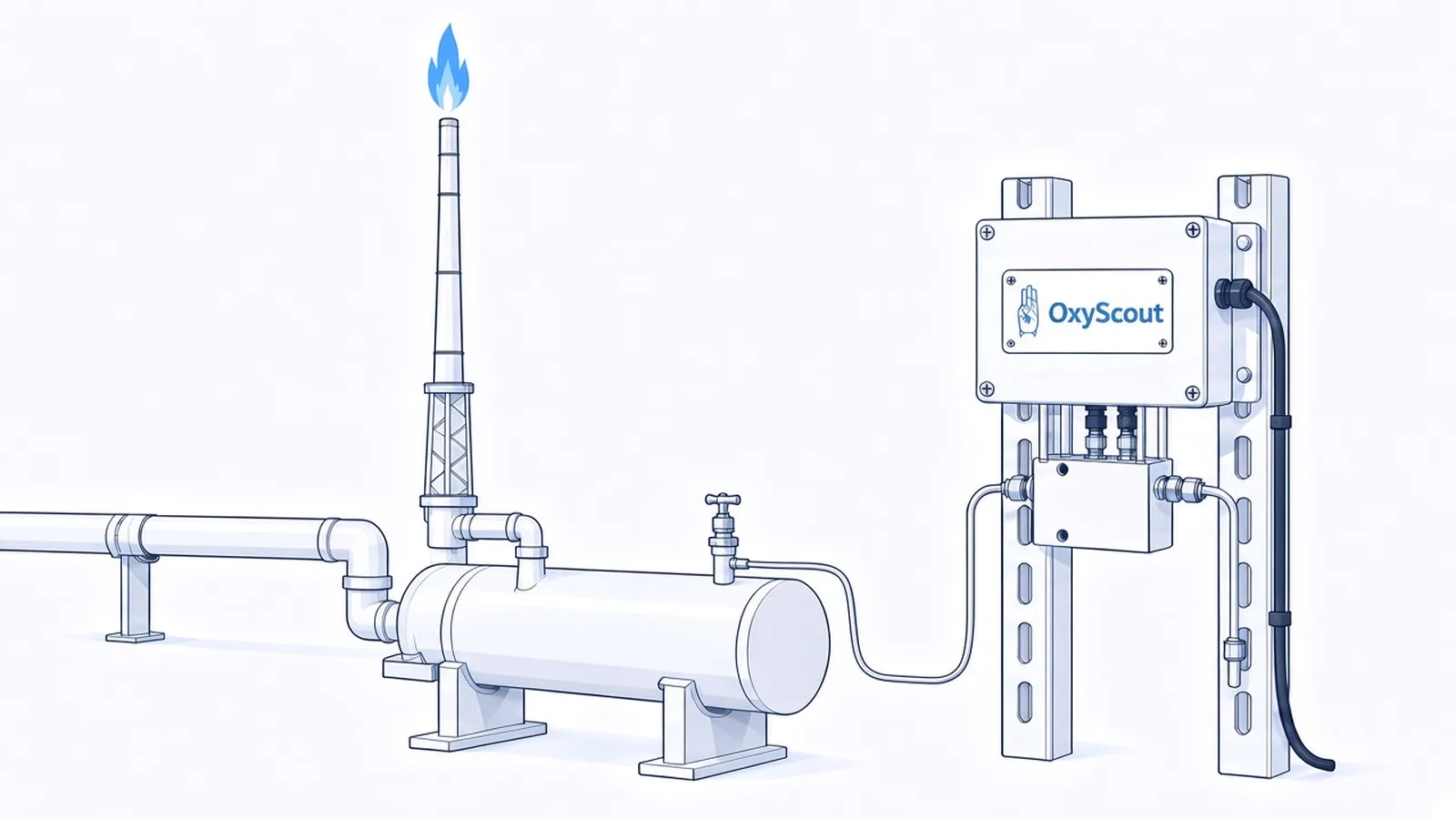
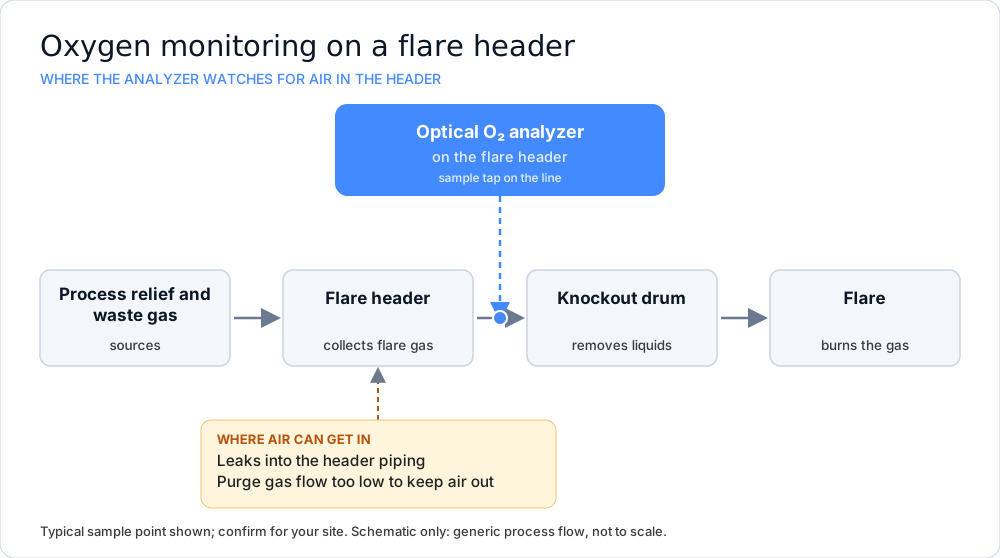
A flare header carries relief and waste gas to the flare. When air gets into that piping, oxygen can mix with hydrocarbon gas and create a flammable mixture inside equipment that was not designed to hold one. Purge gas is used to keep air out, so the open question is whether it is doing so.
A periodic check answers that once. A continuous signal answers it all the time, and can sit in the same SCADA view as the rest of the flare system.
The analyzer mounts on the flare header, where it can see air that has leaked into the piping or that purge flow has failed to exclude.
The signal lets you confirm that purge gas flow is keeping air out of the header, spot air leaking into the flare system, and feed a continuous signal to SCADA in place of periodic checks. The analyzer does not replace flare safety systems or procedures.
| Ranges | The percent-level ranges (0–1 %, 0–10 % and 0–21 % by volume) usually fit, but you should choose the range from the oxygen levels you need to detect. |
|---|---|
| Detection limit* | The limit of detection is ≤ 0.5 ppm O₂ on the Ultra-Trace range (0–50 ppm), 50 ppm O₂ on the Trace range (0–1000 ppm), 0.01 %vol O₂ on the Percent 0–1 %vol range and 0.1 %vol O₂ on the Percent 0–10 % and 0–21 %vol ranges. |
| Accuracy* | Accuracy is ±2 ppm or ±5% of reading, whichever is greater, on the Ultra-Trace range (0–50 ppm). Accuracy is ±0.5% of full scale on the 0–1 %vol Percent range, and ±5% of full scale on the Trace range (0–1000 ppm) and the 0–10 % and 0–21 %vol ranges. |
| Response time* | Typical response time is under 10 seconds. |
| Gas condition | The gas should be non-condensing. The analyzer is rated up to 250 psi without the flowmeter installed. Higher ratings are available if a regulator is installed upstream. Regulator, filter and flowmeter options are available, and you must plan how to handle flare gas condensate. |
| Area classification | The analyzer is engineered for Class 1 Division 2 (Zone 2) hazardous areas, and the IP67 enclosure protects against dust and water. |
| Outputs | The outputs are a 4–20 mA loop (current sink) and RS-485 Modbus RTU (2-wire half-duplex). |
*Based on controlled lab conditions.
Flare gas can carry H₂S and CO₂. OxyScout has no cross-sensitivity to either and no poisoning of the optical sensor, and there is no electrochemical cell to replace.
A tank blanket protects a vapor space on one tank. A flare header is shared piping that collects gas from many sources. Both ask whether air is staying out, but the failure points differ. See tank blanketing.
Yes. A 4–20 mA loop (current sink) or RS-485 Modbus RTU output provides a continuous signal in place of periodic checks.
The percent-level ranges (0–1 %, 0–10 % and 0–21 %) usually fit, and you should choose from the oxygen levels you need to detect.
Bring the header pressure and the knockout drum position. We will go through the sample point and send a quote.
Get a Quote