
For a midstream operator, the custody transfer receipt point is where producer gas enters your system, along with any oxygen that got into it upstream. An optical oxygen analyzer on your own pipeline, just downstream of the fence line, monitors oxygen in the incoming gas continuously against your pipeline limit. You catch an off-spec receipt early, protect your system and the gas you deliver downstream, and keep data to take back to the producer.
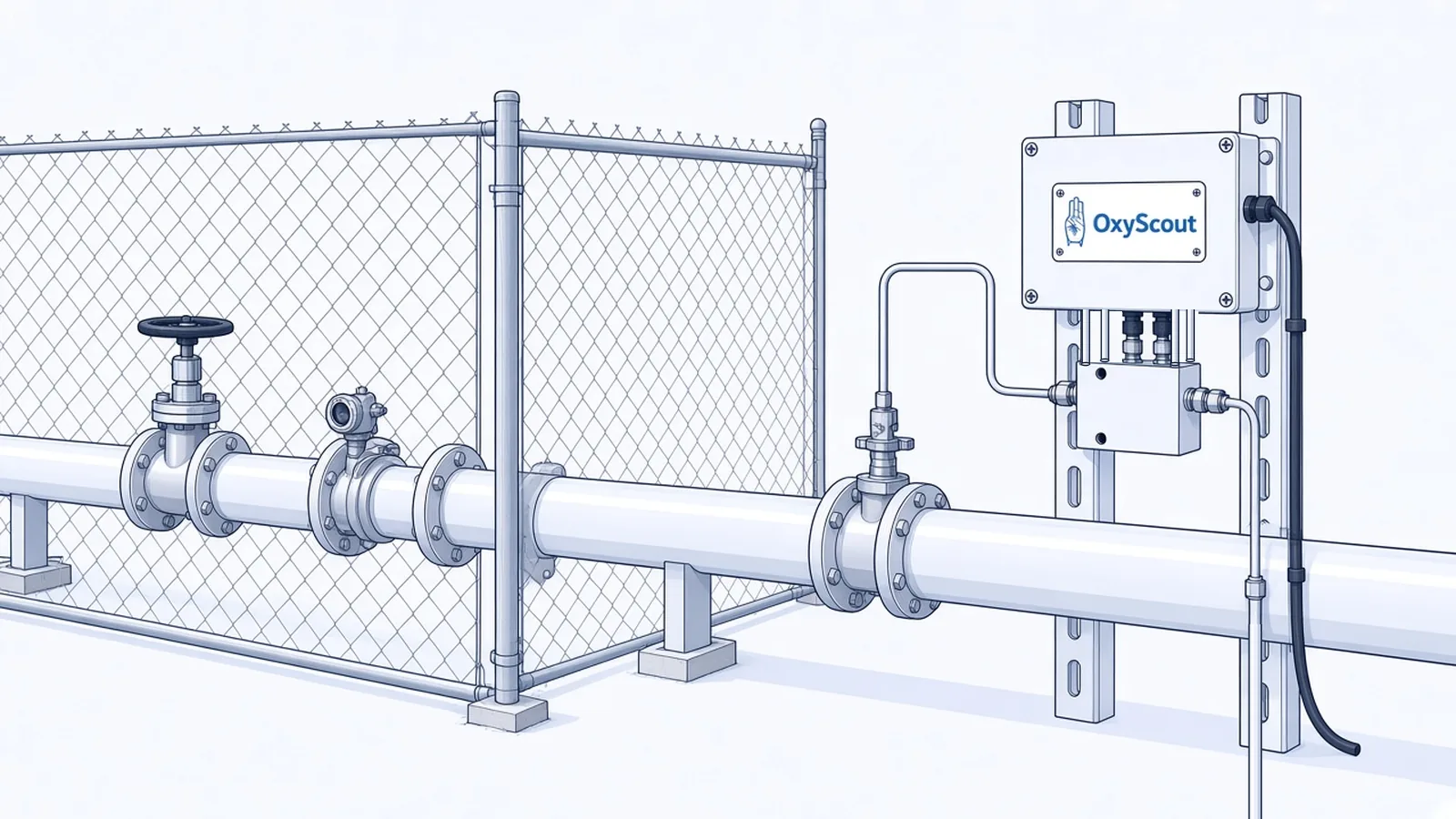

A midstream operator should monitor oxygen on its own pipeline, just downstream of the fence line at the custody transfer receipt point. At that spot the analyzer reads the producer gas you have just received, before the gas blends with other receipts or reaches your compression and processing. The OxyScout optical oxygen analyzer sits on a strut stand on your side of the fence and draws a sample through a tube from a probe tap on the line.
The analyzer monitors oxygen against your pipeline limit continuously while gas flows across the receipt point. If several producers deliver into your system, an analyzer at each receipt point shows which receipt the oxygen arrives through.
The limit at a receipt point depends on your gas gathering or interconnect agreement and on the tariff of the pipeline you deliver into, so read the quality section of each before you set an alarm. As one published example, Cameron Interstate Pipeline's FERC tariff (Section 14.6) allows no more than 0.2 % uncombined oxygen by volume, which is 2,000 ppm. Other pipelines differ, so confirm the number for your interconnect first. The published pipeline oxygen limits page compiles values from 10 ppm to 0.2 % with their sources.
The limit decides the range. A 2,000 ppm limit sits above the top of the 0–1000 ppm range, so it falls in the 0–1 % range. A limit below 1,000 ppm falls in the Trace or Ultra-Trace ranges. Pick the range with your limit inside it, not at the edge.
| Oxygen limit | In ppm | Equivalent air in the gas | Range to consider |
|---|---|---|---|
| 10 ppm (0.001 %) | 10 | About 48 ppm of air, roughly 1 part in 21,000 | Ultra-Trace, 0–50 ppm |
| 0.1 % | 1,000 | About 0.48 % air | Percent, 0–1 %vol |
| 0.2 % (the Cameron example) | 2,000 | About 0.95 % air, just under 1 % | Percent, 0–1 %vol |
The air column is arithmetic only, not a field measurement. The arithmetic assumes that air is about 21 % oxygen and that the gas held no oxygen before air entered. The oxygen in natural gas guide shows the worked numbers.
The oxygen in producer gas comes from air that leaked in at surface equipment on the producer's side of the fence, because reservoir gas is essentially free of oxygen. None of the sources is large alone, but they add up, and the total arrives at your receipt point as one number. With air at about 21 % oxygen, just under 1 % air in the gas is enough to reach a 0.2 % limit. The producer can trace each source at the point where the air gets in:
Screening producer gas at the receipt point protects your own system and the gas you deliver downstream. Once producer gas crosses the fence, any oxygen in that gas becomes part of your stream, so the earlier you see an off-spec receipt, the less of your system that gas reaches.
What you can do about an off-spec receipt depends on your gas gathering or interconnect agreement, so read its quality and notice terms before you plan a response.
When an incoming reading rises, the analyzer's 4–20 mA or RS-485 Modbus RTU signal can feed the alarms, historian or control logic you already use, so your control room sees the rise before the reading reaches your limit. The recorded trend from the receipt point is the data you take back to the producer.
The producer can then trace the oxygen at the source. Analyzers at the wellhead, tank, compressor and gathering taps narrow a high receipt reading to the stage where oxygen first appears, which is where the air is getting in.
| Ranges | Use the 0–50 ppm and 0–1000 ppm ranges for a low-ppm limit, and use the 0–1 %, 0–10 % and 0–21 % ranges for larger upsets and for limits near 0.2 %. Put your limit inside the range. |
|---|---|
| Detection limit* | The limit of detection is ≤ 0.5 ppm O₂ on the Ultra-Trace range (0–50 ppm), 50 ppm O₂ on the Trace range (0–1000 ppm), 0.01 %vol O₂ on the Percent 0–1 %vol range and 0.1 %vol O₂ on the Percent 0–10 % and 0–21 %vol ranges. |
| Accuracy* | Accuracy is ±2 ppm or ±5% of reading, whichever is greater, on the Ultra-Trace range (0–50 ppm). Accuracy is ±0.5% of full scale on the 0–1 %vol Percent range, and ±5% of full scale on the Trace range (0–1000 ppm) and the 0–10 % and 0–21 %vol ranges. |
| Response time* | Typical response time is under 10 seconds. |
| Outputs | The outputs are a 4–20 mA loop (current sink) and RS-485 Modbus RTU (2-wire half-duplex). |
| Pressure | Up to 250 PSI input pressure† |
| Calibration | An optional 3-way valve selects calibration gas or process sample, and an optional pressure regulator and gauge and a secondary filter are available. |
| Area classification | The analyzer is engineered for Class 1 Division 2 (Zone 2) hazardous areas, and the IP67 enclosure protects against dust and water. |
*Based on controlled lab conditions.
†Without Flowmeter installed. Higher ratings if regulator installed upstream.
For a midstream operator, the analyzer mounts on your own pipeline, just downstream of the fence line at the receipt point. From there, the analyzer reads the oxygen in the producer gas you receive before that gas reaches your compression and processing.
Oxygen that enters your system with producer gas travels on to your compression, processing and downstream deliveries. A continuous reading at the receipt point shows an off-spec receipt early and gives you data to take back to the producer.
The producer can trace the oxygen at the source with analyzers at the wellhead, tank, compressor and gathering taps. The stage where oxygen first appears is where the air is getting in.
No. The analyzer is a continuous oxygen monitor, and you should check what your pipeline or contract requires for the official measurement.
A 0.2 % limit is 2,000 ppm, which is above the 0–1000 ppm range, so use the 0–1 % range. The limit of detection on the 0–1 % range is 0.01 %vol O₂ (100 ppm).* *Based on controlled lab conditions.
Bring the oxygen limit from your gas gathering or interconnect agreement. We will pick the range with you and send a quote.
Get a Quote