
Oxygen should not be in natural gas. When it is, it almost always comes from air leaking in at equipment that runs near or below atmospheric pressure. Each pipeline sets its own oxygen limit, so the job is to find where air enters and measure there.
Reservoir gas is essentially free of oxygen. Oxygen in the stream is air drawn in at the surface, through wellheads running at or below atmospheric pressure, tank hatches, VRU suction, compressor seals and gathering-line fittings. Each source is small, but they accumulate toward the sales meter.
Line pressure above atmospheric does not close the door. Oxygen's partial pressure in air is much higher than in the gas, so oxygen can diffuse back through a leak even when the line is above ambient.
Each pipeline publishes its own maximum in its tariff or gas sales agreement, and limits vary by pipeline, segment and contract. One published example: Cameron Interstate Pipeline's tariff (Section 14.6) allows no more than 0.2 % uncombined oxygen by volume. Confirm the limit for your interconnect first.
Oxygen is quoted in ppm by volume at trace levels and in percent above that; 1 % is 10,000 ppm. Air is about 21 % oxygen, so any oxygen reading converts to an equivalent amount of air leaking into the gas. The table assumes the gas held no oxygen before the leak.
| Oxygen in the gas | In ppm | Equivalent air in the gas |
|---|---|---|
| 50 ppm | 50 | About 0.024 % (1 part in 4,200) |
| 0.1 % | 1,000 | About 0.48 % |
| 0.2 % (the Cameron example) | 2,000 | About 0.95 %, just under 1 % |
| 1 % | 10,000 | About 4.8 % |
| 21 % | 210,000 | 100 % (pure air) |
This is arithmetic only and not a field measurement. The table assumes that air is 21 % oxygen and that the gas contained no oxygen before the leak.
The analyzer ranges follow from this. The 0–50 ppm and 0–1000 ppm ranges (Ultra-Trace, Trace) cover limits below 0.1 %. The 0–1 %, 0–10 % and 0–21 % ranges (Percent) cover limits near 0.2 % and larger upsets.
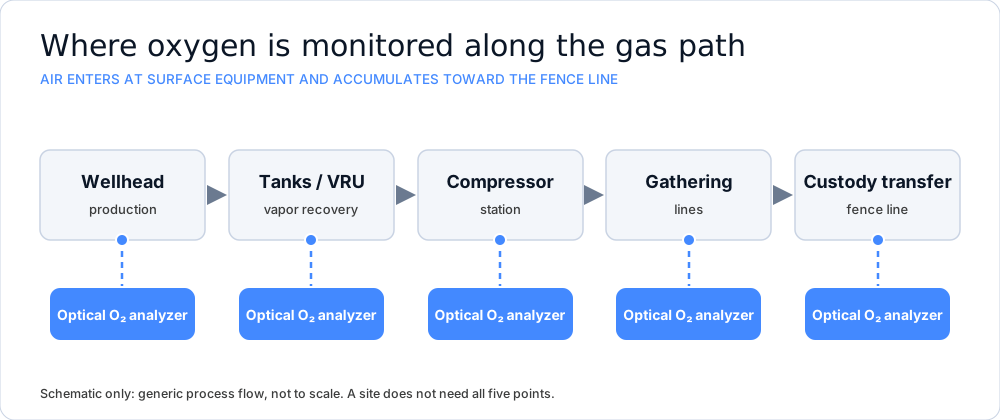
| Where | What to watch | Page |
|---|---|---|
| Wellhead and production | Air can get in at low-pressure, plunger-lift and stripper wells. | Wellhead and production |
| Tanks and VRU | Thief hatches and vacuum on the VRU suction can let air in. | Vapor recovery units |
| Compressor station | Rod packing and shaft seals can let air in. | Compressor stations |
| Gathering | Fittings, packing, welds and tie-ins can let air in. | Gathering lines |
| Custody transfer | The cumulative total is compared against the tariff limit. | Custody transfer |
Measure at a source to find a leak, and measure at the fence line to see the total. If you need to trace a high reading, use more than one point, because the stage where oxygen first appears is where air is getting in. See the optical oxygen analyzer for ranges and outputs.
Reservoir gas contains essentially no oxygen. Any oxygen is air that entered at the surface, and the acceptable level is whatever your pipeline's tariff allows.
One percent by volume is 10,000 ppm by volume.
Just under 1 % air in the gas is enough. Air is about 21 % oxygen, so 0.2 % oxygen is about 0.95 % air, assuming the gas held no oxygen before the leak.
Air gets in at wellheads on vacuum, tank hatches, VRU suction, compressor seals, and gathering-line fittings, welds and tie-ins.
Measure at more than one point. The stage where oxygen first appears is where air is getting in.
Book a 30-minute meeting to review your application and we'll send you a quote after the call.
Get a Quote